A dust bath that leaves a mark.
Why a shallow hollow deserves a second look.
An ordinary behaviour
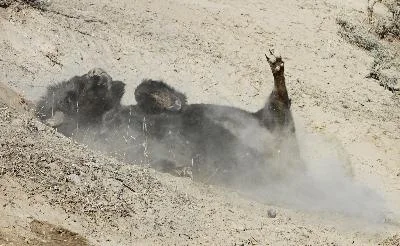
Bison wallowing involves rolling on loose ground. Along with grazing and movement, it is one of the ways a herd changes its surroundings. The resulting depressions are part of the physical record of animals using a place.
A small feature, a larger question
A wallow gives a visitor a reason to think beyond the animal itself. What does repeated disturbance do to soil and vegetation? How does the same patch look after rain? Those questions are useful even when the answer requires more than one visit or a specialist study.
Watch without moving closer
Curiosity is not a reason to approach a bison or step into its space. Use optics from an appropriate viewing position and follow current park instructions. A photograph that includes a wider view often tells the story more clearly than an intrusive close-up.
Leave a careful note
Describe the feature without collecting soil, disturbing the site, or assuming every bare patch is a wallow. Record what led you to the identification and what you remain unsure about. A cautious observation can be more informative than a confident guess.
Check current local park guidance before a visit. Observe from a distance and follow posted instructions.